
15 September 2022

An augmented reality retail experience for kids and families

Using new technology to attract and retain customers to stores is top-of-mind for many retailers. But how do you design an engaging, playful in-store experience for kids and families?

Together with Coop Sweden, one of the largest grocery chains in Sweden, and Information Experience, an innovative platform using AR and VR to bring 3D models to construction, we set out to solve this question.

We wanted to give parents a shopping experience where they feel more relaxed and less stressed, and kids an experience where they have more fun while being involved in daily tasks such as getting groceries.

Jump to:
A blue and white paper with the word pdf on it.
Free PDF guide!
Download

Key learnings

  • You can’t always design the experience after the technology’s “best practice”. You need to design the experience after kids' behaviors, and adapt and apply the technology thereafter.
‍
  • Consumer-focused indoor navigation is a new, untouched field. An iterative, risk-taking mindset is needed. Embrace the challenges - they will come!
‍
  • The digital opportunities for retailers to create engaging experiences is massive. Step out of your comfort zone. Dare to innovate if you want to win.

Core design principles

When designing games for kids the key to an engaging experience is to have a kids-first-approach. In our world, that means two things.

1. Design with empathy (& humor)
Put yourself in the shoes of a child. How do kids play? What do they find fun and exciting? What platforms are they on? Most importantly, have you asked them?

In the end, if kids don’t find it playful and engaging, then whatever cool, innovative technology you’re using won’t matter.

2. Design age-appropriately
A 4-year old and a 6-year old are very different in terms of their cognitive, physical and emotional capabilities. This will affect the user interface and game design, especially when dealing with Augmented Reality (AR).

You want the child to feel confident in her ability to play the game, yet give enough “challenges” and appropriate feedback so she feels engaged.

Applying design principles in a retail setting

Supermarkets offer large play areas, similar to playing outdoors. We immediately stepped into the mind of a 6 year old, and started brainstorming different ways we would play outdoors: Tag, Capture the flag, Pokemon Go, Hide-and seek and other made-up adventures like scavenger hunts. Those are all fun!While thinking of outdoor play, we also had to keep in mind that navigating large stores and finding ingredients can be challenging. It sometimes leaves us feeling frustrated and stressed, and we didn’t want this to happen to kids because then we’d lose their interest...

The idea
Augmented Reality + Scavenger Hunt = Success!

That’s when the idea of a mobile Augmented Reality (AR) recipe scavenger hunt was born. It’s an engaging game concept for kids that comes with great educational bonuses.Scavenger hunts help with developing: 1. Problem-solving skills, 2. Teamwork, and 3. Connecting body and mind.

Still, we knew that this would be a challenging task...

Indoor navigation from a customer-focused perspective had never been done in this environment before, and it had to be made fun!
Adding playfulness
How will kids find it engaging?

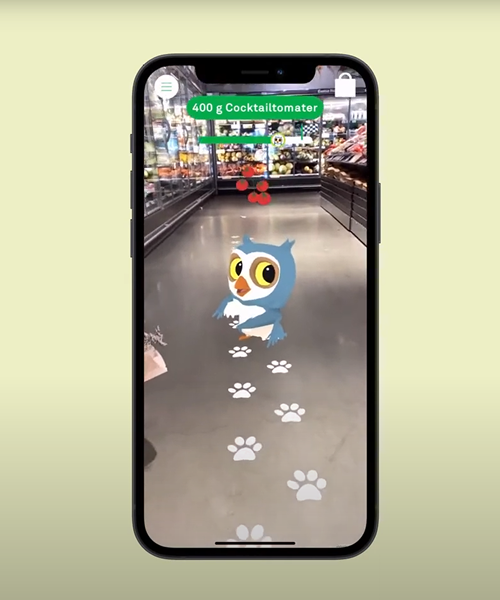
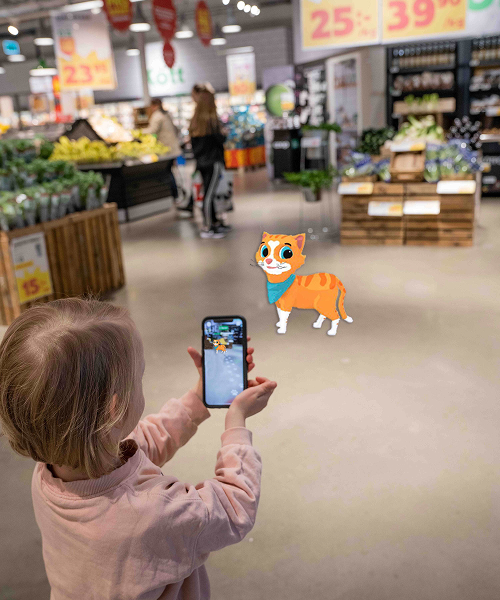
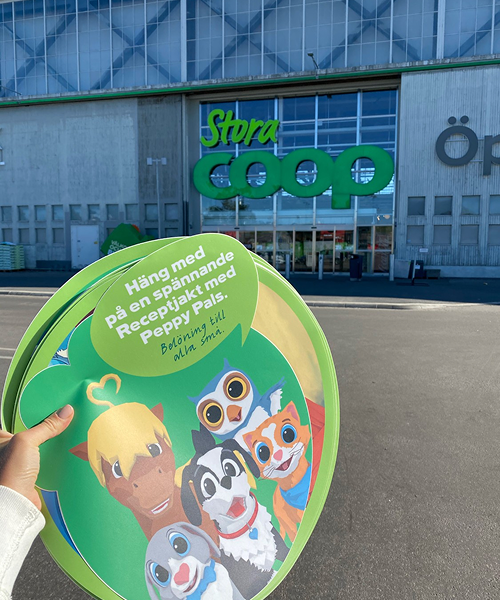
Storytelling and imaginative play is key to kids' engagement. Therefore we designed the game around five animated characters: a dog, a cat, an owl, a rabbit or a horse.

These characters know the store by heart and sit on important clues. They become kids' "secret detectives", meaning kids are the only ones that can see the character in the store as they are projected using AR.

The task is to follow the character to reach the different ingredients, and eventually collect all needed for the recipe. When a child reaches an ingredient the character will cheer, jump, dance or do a silly move like headbanging. It’s all about the surprises!

The technology
How to make it real?

Navigating large spaces with precision requires powerful technology. We needed a solution that could track distances within just a few meters, ensuring kids didn’t end up at cucumbers when searching for tomatoes—and keeping play safe for everyone.

Finding the right tech wasn’t easy, especially indoors. After months of testing, we struck gold with Microsoft’s Azure Spatial Anchors. This technology provides consistent navigation in large indoor spaces like Coop supermarkets, constantly adjusting to maintain accuracy.

To make it even sharper, we added image tracking. At the start of the game, kids point their camera at a floor marker, giving the app their exact starting point. This quick “fix” lets the scavenger hunt begin with speed and precision.

No items found.

What’s next?

Designing the best AR retail experience for kids isn’t just about technology!
It’s about empathy, imagination, and a willingness to experiment. By combining storytelling, play, and precise navigation, we’ve proven that shopping can be transformed from a stressful chore into a fun, family-friendly adventure.

The pilot is only the beginning, and we’re excited to keep learning, iterating, and inspiring new ways for retailers to create meaningful, joyful connections in-store.

We hope you’ve enjoyed this article!

Any thoughts or questions on your mind?
Get in touch

Keep reading

Kids love AI—here’s what your brand needs to know
Practical guides
Research & Trends
There’s a risk to AI you might be missing
Research & Trends
Practical guides
12 ways to earn trust in your AI—with examples
Practical guides
Research & Trends